For many owners, valuation improvement feels like a growth story. Push revenue. Lift margins. Improve EBITDA. Show momentum.
Performance matters, of course. But valuation weakens when scrutiny exposes something that should have been dealt with earlier. It drains away in adjustments. In caveats buried in draft heads of terms. In buyer questions that uncover inconsistencies or assumptions no one had written down. A headline number that once looked strong starts to feel conditional.
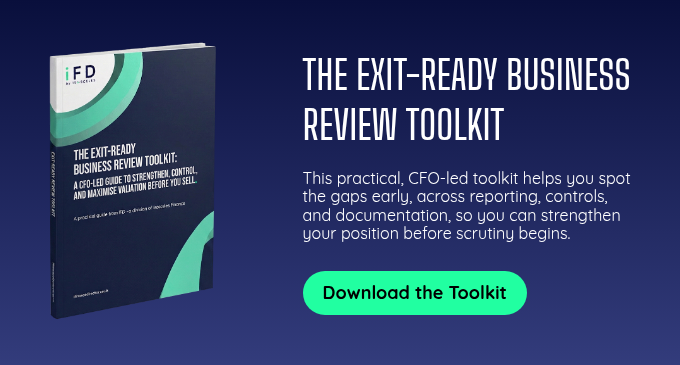
If you want a structured way to assess where those risks may sit in your own business, our Exit-Ready Business Review Toolkit offers a CFO-led scorecard and documentation checklist to benchmark your readiness before a process begins.
Buyers look at durability:
Does reporting stay coherent under pressure?
Can the business operate without leaning too heavily on one individual?
Do forecasts survive challenge?
Does documentation signal control, or inconsistency?
When certainty fades, pricing follows.
Many successful businesses carry weaknesses that stay hidden in normal trading. Due diligence has a way of flushing them out. By then, leverage has shifted. Maximising valuation is about removing doubt before someone else spots it.
This article explores where valuation erodes during scrutiny, the hidden weaknesses buyers typically uncover, and the practical steps that protect value before a process goes live.
WHAT VALUATION IMPROVEMENT ACTUALLY MEANS BEFORE A SALE
It’s easy to think valuation improvement begins with a spreadsheet. It actually begins when you imagine a buyer reviewing your business and asking whether it would function in the same way if you stepped back.
We’ve sat with leadership teams confident in performance. Revenue is steady. Margins are healthy. Cash is controlled. Then due diligence starts and the tone changes. It becomes detailed. Specific. Methodical. That is when valuation often starts to feel exposed. Valuation is shaped by perceived risk as much as performance, and risk reveals itself in the structure of the business:
- Leadership dependency.
- Reporting consistency.
- Undocumented processes.
- Systems reliant on workarounds.
Buyers want clarity on how much truly depends on one individual. They test whether performance can be explained without layers of clarification. They look for evidence that controls are not only written down but consistently followed, and they expect forecasts to withstand direct challenge.
When those areas are supported by evidence, confidence increases. When they require explanation, caution increases.
Valuation improvement is structural work. It shows up in clean reporting, documented control, defined ownership and forecasts aligned to strategy. Businesses that appear similar on paper can receive very different valuations because their coherence under scrutiny differs.
These are the same areas assessed within the Exit-Ready Business Review Toolkit scorecard.
Many businesses discover they are neither fundamentally weak nor fully ready, simply carrying structural gaps that have never been formally tested. Identifying those gaps early preserves leverage.
WHY VALUATION ADJUSTMENTS HAPPEN DURING DUE DILIGENCE
When valuation shifts during a sale process, it rarely happens because a buyer suddenly discovers something dramatic.
More often, it happens because scrutiny reveals gaps in clarity, documentation, or operational control. These gaps increase perceived uncertainty. Uncertainty influences how risk is assessed. Risk influences pricing.
Understanding this early is essential. It allows you to address the areas buyers examine most closely before a live process begins.
Below is a simplified view of where valuation pressure typically emerges.
| AREA REVIEWED DURING DUE DILIGENCE | WHAT BUYERS LOOK FOR | WHAT STRENGTHENS VALUATION |
|---|---|---|
| Revenue quality | Concentration risk, recurring income clarity, contract terms, and steady growth trajectory | Documented customer concentration analysis, clearly defined recurring revenue, contract summaries readily available, and clear visibility of continued growth potential |
| Reporting & visibility | Consistent month-end reporting, meaningful KPIs generating business insight, fully reconciled financials, and clear divisional performance visibility | Clean management information that aligns across board packs and forecasts |
| Systems & controls | Manual workarounds, spreadsheet dependency, and documented processes | Defined controls, system integrations, documented procedures |
| Leadership & dependency | Leadership reliance, unclear succession, informal decision-making | Delegated ownership, documented roles, visible second-line leadership |
| Forecasting & forward planning | Assumptions under pressure, lack of downside analysis | Structured forecasts linked to strategy, scenario modelling aligned to operational drivers |
| Documentation readiness | Missing contracts, inconsistent HR files, reactive data gathering | Organised data room, indexed documentation, named document owners |
None of these areas are unusual. Many businesses carry a mix of strengths and gaps long before a sale is considered. The difference is how early those gaps are identified and strengthened, while timelines are still flexible.
Challenges around reporting clarity and fragmented oversight often appear during growth. In how limited visibility hurts growing businesses, we discuss how siloed data, manual processes and disconnected systems reduce organisational visibility and operational control. When those issues remain unresolved, they can create pressure once external review begins.
Preparation becomes more complex when documentation and governance are addressed reactively. Our Exit Planning services focus on strengthening clarity, control and buyer readiness before a transaction is live, so improvements are embedded rather than rushed.
Each of these areas connects directly to valuation improvement because they influence how stable and transferable the business appears under examination.
The earlier these foundations are reviewed internally, the more control leadership retains over how the business is assessed during diligence.
THE FIVE AREAS BUYERS TEST – AND WHERE VALUE ERODES
When buyers begin due diligence, they’re testing the credibility, sustainability and risk profile of your business. What looks tidy on a spreadsheet can unravel once a buyer digs deeper, and these hidden issues can materially erode valuation or negotiating leverage.
1. Fragmented or Inconsistent Financial Reporting
Incomplete, disorganised or inconsistent financial records are far more than a nuisance in diligence. Buyers use these documents to verify performance and forecast future earnings. When management accounts don’t tie to statutory filings or cash flow forecasts aren’t supported by historical trends, confidence drops, and valuation can be renegotiated down or deals delayed.
This “trust deficit” often arises because internal reporting hasn’t kept pace with business growth.
2. Weak Internal Controls and Governance
Informal processes for approving expenses, managing cash or controlling procurement might work day-to-day.
However, they signal risk in a sale process. During diligence, weak controls increase the chance of errors or financial misstatements. All of which buyers treat as valuation risk. For buyers, stronger governance is certainty and predictability.
3. Undisclosed Liabilities and Accounting Policies
Diligence teams routinely search for off-balance-sheet liabilities: deferred obligations, unrecorded liabilities or aggressive revenue recognition. These can lead to adjustments in reported profits or working capital, later reflected in lower valuations or tighter deal terms.
Similarly, inconsistent accounting policies make future forecasts less reliable, pushing buyers to apply discounts to valuation assumptions.
4. Strategic and Operational Dependencies
Buyers increasingly look beyond financials. Operational fragilities, such as overdependence on key personnel, outdated systems, or untested succession plans, influence how future earnings are perceived.
Strategic weaknesses often emerge only under scrutiny, yet they directly affect buyers’ valuations. In SME deals, this can widen the valuation gap between what owners expect and what buyers are prepared to pay.
5. Revenue and Customer Concentration Risk
One of the most common valuation drags is heavy reliance on a small number of customers. Even profitable firms can see valuations trimmed if a large share of revenue comes from one or two clients, because buyers see this as concentrated risk.
Buyers worry that if that customer relationship changes post-transaction, the business’s future cash flows and stability diminish.
That perceived uncertainty typically translates into lower multiples and valuation, not full price.
TURNING WEAKNESS INTO VALUATION IMPROVEMENT AND STRENGTH
If you’ve worked through the Exit-Ready Business Review Toolkit, these themes will already feel familiar. And the question now is how early they are addressed.
Remember, none of the weaknesses above mean your business is fundamentally flawed. They mean it has grown.
At iFD, exit readiness is approached as an 18-month discipline – embedding stronger reporting, governance and leadership transferability in a way that strengthens the business without disrupting day-to-day momentum.
Most established SMEs evolve organically. Systems adapt. Reporting develops around what is needed at the time. Responsibilities settle around trusted individuals. That works in normal trading.It feels efficient. Familiar.
Due diligence is different. It changes the lens.
The advantage is this: the majority of valuation risks are identifiable and fixable when addressed early. The difference between a pressured adjustment and a confident defence often comes down to timing.
Here are practical steps that move you from exposure to control.
1. Tighten Reporting Before It Is Tested
Strong reporting is one of the fastest ways to build buyer confidence.
Focus on:
- Consistent month-end close within a defined timeframe.
- Reconciled management accounts aligned with statutory figures.
- Clear separation of recurring and one-off costs.
- Divisional or product-level performance.
- Forecasts supported by documented assumptions.
This is not about cosmetic improvement. It is about coherence. When your management information reads like a due diligence pack before diligence begins, you retain leverage.
iFD’s Exit Planning support often begins here, strengthening reporting structure and ensuring your final full trading year before sale tells a disciplined, credible narrative.
2. Document Control and Governance
Informal processes may work operationally. They do not work in a transaction.
- Document approval authorities and delegated responsibilities.
- Remove manual spreadsheet dependencies where possible and map key finance and operational processes.
- Establish one verified source of truth for reporting.
Control that is written down carries more weight than control that is implied.
iFD’s fractional CFO model embeds experienced leadership within your existing team structure. Rather than advising from the sidelines, we operate inside the reporting cadence. We strengthen controls, align forecasts to strategy and prepare documentation progressively, so readiness builds without operational disruption.
3. Quantify and Reduce Revenue Risk
If customer concentration exists, measure it clearly. Do not wait for a buyer to calculate it for you.
- Analyse revenue by customer over the last three years.
- Identify contract terms, renewal points and notice periods.
- Model downside scenarios if a key client reduces spend, and upside scenarios if that client increases investment.
- Develop diversification plans or strengthen contractual security where possible.
Buyers accept risk when it is visible and managed. They discount risk when it is unclear.
An experienced fractional CFO will help you frame concentration risk in context, linking it to contract strength, retention history and pipeline depth rather than leaving it as a headline percentage.
4. Address Leadership Dependency Early
If the business depends heavily on you or one senior individual, begin redistributing knowledge and responsibility now.
- Clarify second-line leadership roles.
- Document decision rights.
- Formalise succession or interim cover plans.
- Align incentives and employment terms.
Buyers pay more for transferability. A business that can operate without leaning on one person feels investable.
5. Build Your Data Room Before You Need It
Reactive documentation gathering creates stress and weakens negotiating position.
Instead:
- Create a structured data-room.
- Assign named owners for each document category.
- Review HR, legal and financial records for completeness.
Preparation reduces pressure. Pressure reduces options.
You Do Not Need to Fix Everything at Once
Exit readiness is prioritisation, and the key questions you need to ask yourself are:
- Which weaknesses would most influence valuation?
- Which improvements strengthen buyer confidence fastest?
- What can realistically be embedded within 18 months?
This is where experienced CFO guidance makes a measurable difference. iFD’s Exit Planning services are designed specifically for owner-led SMEs who want structure without unnecessary overhead. Fractional CFO and FD support provides:
- A clear readiness assessment.
- A sequenced 18-month improvement plan.
- Hands-on strengthening of reporting and controls, and calm preparation for scrutiny, not reactive firefighting.
The goal is simply clarity, confidence and control.
Start With a Clear View of Where You Stand
Throughout this article, we’ve explored the areas where valuation typically comes under pressure. Reporting clarity, revenue quality, governance discipline, leadership dependency and documentation readiness.
These are not abstract concepts. They are practical, testable elements of exit readiness.
That is precisely why we developed The Exit-Ready Business Review Toolkit, to give owner-led SMEs a structured, CFO-led way to assess these foundations before scrutiny begins.
The Toolkit provides:
- A practical readiness scorecard across the five areas buyers test.
- A buyer-ready documentation checklist.
- An 18-month roadmap aligned to valuation protection and transferability.
It is the same structured lens used to assess transaction readiness before a process goes live. If you are considering a sale within the next 12–24 months, or simply want confidence that your business would withstand examination – begin there.
Download The Exit-Ready Business Review Toolkit and benchmark your position calmly, privately and with clarity.
When clarity improves, confidence follows. And confidence is what buyers ultimately pay for.