This exit readiness checklist is designed to test a simple question:
If a buyer evaluated your business tomorrow, would it withstand sustained scrutiny across finance, operations and leadership?
It’s easy to assume strong performance equals readiness. However, the market suggests otherwise. Research from the Exit Planning Institute indicates that up to 70-80% of privately held businesses listed for sale do not complete a transaction within 12 months.
More telling is why deals break. Axial’s 2025 Dead Deal Report found that over 46% of failed transactions collapsed during due diligence, driven by earnings discrepancies, undocumented processes and operational risks that surfaced late in the process. In many cases, months of negotiation unravel once scrutiny intensifies.
Strong businesses struggle when visibility, documentation or leadership resilience cannot withstand interrogation.
You can use this fast exit readiness checklist as a calm diagnostic. Ten practical signals that highlight where friction could surface, and where early action protects valuation long before you formally go to market.
The signals below reflect the same readiness pillars used in our Exit-Ready Business Review Toolkit. Revenue quality, product and market position, leadership resilience, reporting clarity, and financial control, but presented here as a rapid sense-check before deeper benchmarking.
Exit Readiness Checklist – 10 Signals Buyers Notice First
1. You Can’t Easily Show Where Performance Really Comes From
If someone asked you:
- Which product lines generate the highest margin?
- Which customers are most profitable and valuable?
- Where has the margin tightened in the past 12 months?
Could you answer without asking your team to rebuild a spreadsheet?
Many established businesses perform well overall. But when buyers look closer, they want to see exactly how profit is generated and how resilient it is.
Recent M&A analysis from Axial found that earnings discrepancies and documentation gaps are now among the most common reasons deals fall apart during due diligence.
Often, the issue is not performance. It is clarity.
If your profitability story takes time to reconstruct, your leverage weakens. Buyers interpret delayed clarity as earnings risk, and earnings risk directly reduces pricing confidence.
That is the first signal on any serious exit readiness checklist.
2. Your Forecast Only Makes Sense Because You Explain It
Ask yourself:
- Could someone else walk a buyer through your projections?
- Are the assumptions written down?
- Do they clearly link to sales pipeline, pricing, hiring plans and costs?
Buyers will test what happens if revenue slows, if costs rise, or if a key contract slips. They will not take comfort from “we’re confident”. They want to see how the numbers were built. If the logic lives mostly in your head or with one trusted finance lead, that creates risk.
An exit readiness checklist is as much about resilience as it is about performance.
3. The Business Still Relies Heavily on You
This is common. It is also fixable.
Consider:
- Are you still the main relationship holder for major clients?
- Do key supplier negotiations run through you?
- Would the business stall if you stepped back for three months?
Research from the Exit Planning Institute highlights owner dependency as one of the most consistent contributors to failed sales. Buyers do not just assess the numbers. They assess what happens after you leave.
If too much sits with you, buyers either lower their offer or structure protection into the deal.
Value increases when responsibility is visible beyond the CEO and leadership teams.
4. Working Capital Surprises You
A quiet warning sign:
- Debtor days creep up without a clear reason.
- Inventory builds faster than sales.
- Cash feels tighter at certain points in the year.
- You rely on instinct rather than structured review.
During a sale, working capital becomes central, and buyers look closely at:
- Aged debt.
- Stock valuation.
- Payment patterns.
- Seasonal cash swings.
Axial’s 2025 analysis of broken deals shows that a significant proportion now collapse after deeper diligence findings, not headline valuation disagreements. Often, that friction starts with inconsistencies in how working capital behaves under pressure.
If cash flow mechanics feel “managed” rather than clearly controlled, that is a signal. Buyers read volatility in working capital as transaction risk. This often leads to tighter deal structures or lower headline value.
An exit readiness checklist should always test how predictable your cash cycle really is.
5. Your Reports Reconcile Eventually – Not Instantly
Imagine this scenario: A buyer compares management and statutory accounts, CRM revenue data and operational KPIs, and the figures do not align straight away.
Just small inconsistencies that require explanation.
- Each explanation costs time.
- Each delay erodes confidence.
- During due diligence, friction compounds.
Research consistently shows that documentation and reporting gaps account for a large share of failed transactions once exclusivity begins. The issue tends to be cumulative. If your reporting requires interpretation rather than alignment, that is a readiness gap.
Clean reconciliation signals control. Inconsistency, however small, signals fragility, and fragility shifts negotiating power.
6. Your Documentation Is Organised, But Not Buyer-Ready
This one feels subtle.
You may have:
- Contracts
- HR records
- Financial statements
- Board papers
- Policies
But ask yourself:
- Are they centralised?
- Are they current?
- Are responsibilities clearly assigned?
Insufficient financial documentation remains one of the top reasons SME transactions fail. It is not the absence of documents that causes problems. It is the absence of structure. And when documentation is scattered, timelines extend, teams feel the pressure, and questions multiply. Eventually, negotiating leverage shifts.
An effective exit readiness checklist can test order. It can also test how well the business would perform under sustained scrutiny.
7. You Haven’t Defined Who You’re Selling To
Of course, not all buyers value the same things. For some, recurring revenue will be the priority, for others it could be about IP, management depth or sector entry.
If you cannot answer this question clearly:
“Who is our most likely buyer, and what would they pay a premium for?”
Then your final trading year may be telling the wrong narrative. And without a defined buyer profile:
- KPIs drift.
- Investment decisions lack focus.
- Reporting does not highlight what matters most.
8. Month-End Still Feels Like a Fire Drill
If month-end involves:
- Last-minute reconciliations.
- Late adjustments.
- Manual intervention.
- Stress across the team.
Then buyers will assume the system relies on effort rather than design.
A consistent, well-managed month-end process signals a business built on structure rather than personal effort. And it is one of the simplest areas to strengthen before scrutiny makes any cracks visible.
9. Your Senior Team Is Not Protected by a Clear Retention Plan
Ownership change creates uncertainty. Even in strong businesses. From the moment a transaction is announced, or even rumoured, senior leaders may begin to ask:
- What happens to my role?
- What happens to my team?
- What happens to my compensation?
PwC’s deal research highlights how material this risk is. 82% of companies that reported significant value loss after an acquisition also lost more than 10% of employees post-close. Retaining key employees has also become more difficult in recent years, with reported retention success rates falling from 56% to 41%.
That is why retention planning is now standard practice. WTW’s 2024 European M&A Retention Study found that over 60% of acquirers set aside fixed budgets for retention pools to secure key executives and critical talent during and after a transaction.
If your senior team:
- Has no defined post-exit role.
- Has no retention structure.
- Has no incentive to remain through transition.
Buyers interpret leadership instability as post-transaction execution risk and price that uncertainty accordingly. An effective exit readiness checklist tests whether leadership stability is structured.
10. Planning to “Tidy Things Up” Once the Sale Starts
This is the quiet risk.
It sounds practical:
- “We’ll tighten reporting once we appoint advisers.”
- “We’ll formalise that before signing.”
- “We’ll address that during due diligence.”
But once a deal is live:
- Timelines compress.
- Questions multiply.
- External advisers set pace.
- Emotional pressure increases.
Axial’s 2025 deal analysis shows that transactions now spend an average of over 100 days under exclusivity before breaking when issues surface late in the process.
By that point, momentum is hard to rebuild. Preparation is most powerful when you still control the timetable. Exit readiness helps resolve avoidable friction before scrutiny begins.
What This Exit Readiness Checklist Is Really Telling You
If you recognised your business in a few of these signs, it signals that growth has been driven by experience and trust rather than formal process. Most established SMEs evolve around trust, experience and effort. That works extremely well in normal trading. It becomes more visible under scrutiny.
The ten signals above reflect the same pillars buyers test formally during due diligence. These are revenue quality, product and market position, leadership resilience, reporting clarity, and financial control.
This is where iFD’s embedded fractional CFO model adds value. Working within your existing leadership structure, iFD sequences improvements over a defined 12-18-month horizon. Reinforcing financial control, aligning reporting to buyer expectations, and building exit readiness progressively, without disrupting day-to-day trading.
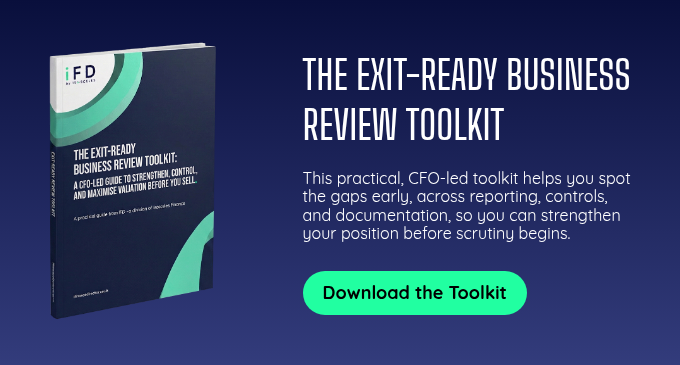
Our Exit-Ready Business Review Toolkit expands this checklist into a structured CFO-led framework, including:
- A scored readiness review across those five pillars
- A buyer-ready documentation checklist
- An 18-month implementation roadmap
- A red-flag map identifying where valuation typically softens
If this article highlighted potential friction, the Toolkit shows you precisely where you stand, and what to prioritise next.
It is designed to help you assess readiness privately and calmly, long before advisers, buyers, or bankers become involved. If an exit could be on your horizon, even within the next few years, clarity now protects leverage later.
Download the Exit-Ready Business Review Toolkit and understand where you stand.